
HIERARCHY
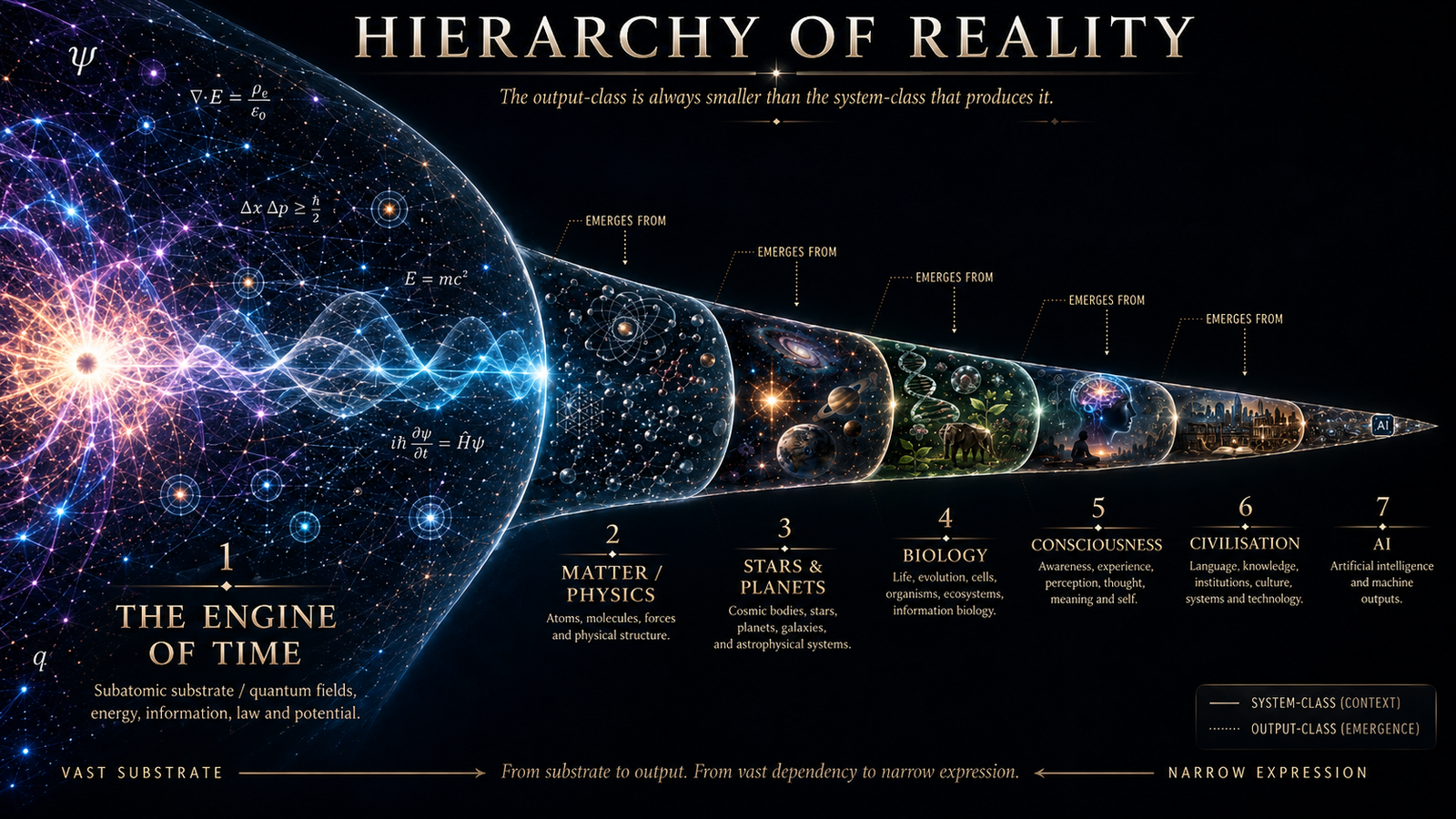
HIERARCHY
Hierarchy is not domination. Hierarchy is dependency.
It is the order by which an output-class emerges from a system-class and remains dependent on the system-class that produced it.
A book is not larger than the language, mind, culture, paper, energy, printing system, and civilisation required to produce it. A car is not larger than the mines, factories, roads, fuel systems, labour, design knowledge, finance, logistics, and planetary extraction required to produce it. A phone is not larger than the rare earths, satellites, data centres, software, undersea cables, labour systems, supply chains, and energy grids required to produce it. AI is not larger than the human, biological, linguistic, computational, institutional, energetic, and planetary substrate required to produce and sustain it.
The output is always smaller than the system of its production.
Not always smaller in appearance. Not always smaller in financial value. Not always smaller in symbolic power. But smaller in total dependency. Smaller in total resource history. Smaller in total causal structure. Smaller in total substrate.
This is the rule.
The finished product never contains the full cost of its own becoming.
That is Hierarchy.
APPEARANCE ILLUSION
The product appears complete because the production system has disappeared from view.
The object sits in the hand. The system that produced it spans the planet. The output becomes visible. The substrate becomes distributed. And because the substrate is distributed, hierarchy becomes hidden.
This is why modern civilisation so easily mistakes outputs for independence.
It sees the product. It does not see the mines. It sees the machine. It does not see the energy system. It sees the city. It does not see the watershed. It sees the data centre. It does not see the water, power, minerals, labour, cooling, law, peace, and institutional stability required to keep it alive.
Hierarchy is hidden because the output is visible and the substrate is distributed.
That is the first illusion.
SCALE ILLUSION
The second illusion is scale.
A supertanker is enormous to a human body. But it is tiny relative to the ocean.
A city is enormous to one person. But it is tiny relative to the planet.
A data centre is enormous to a village. But it is tiny relative to the energy, water, silicon, fibre, climate, capital, and social trust required to sustain it.
A Mars colony would appear immense to the human observer. It would appear as a civilisational triumph. It would appear as proof that humanity had escaped planetary dependency. But it would still be an output-class. It would still be smaller than the system-class required to produce it.
Earth industry. Human biology. Launch systems. Robotics. Energy. Chemistry. Governance. Time. Coordination. Memory. Food. Medicine. Maintenance.
The colony would not defeat hierarchy. It would reveal it.
The output looks vast because the observer is small, not because the substrate has been outranked.
Human awe is not a measurement system.
Scale relative to the observer is not scale relative to reality.
This matters because the modern world is built to inflate outputs at the scale of human awe.
A rocket launch looks like escape. A skyscraper looks like power. A supercomputer looks like intelligence. A market valuation looks like value. A city looks like permanence. A rendered future looks like inevitability.
But none of these abolish hierarchy. They only move the observer’s attention from dependency to spectacle.
Awe is not alignment. Spectacle is not substrate. Visibility is not independence.
ILLUSIONS THAT HIDE HIERARCHY
Hierarchy is not hidden because it is complicated. It is hidden because civilisation is trained to look at outputs.
The finished thing looks self-contained. The phone looks like the phone. The car looks like the car. The building looks like the building. The AI model looks like the AI model.
But no output is self-contained.
Every output carries a hidden production chain.
Materials. Energy. Labour. Knowledge. Law. Transport. Maintenance. Waste. Time.
COMPRESSION ILLUSION
The finished object compresses vast history into a single form. Humans then mistake the compressed object for the total system.
That is the compression illusion.
The object appears small and complete. The substrate is large and missing.
The phone does not display the mine. The car does not display the refinery. The cloud does not display the water. The algorithm does not display the human language that trained it.
The finished product never contains the full cost of its own becoming. It carries the shape of dependency, not the total dependency itself.
OWNERSHIP ILLUSION
This is why ownership becomes confused with control.
A person may own a device. A company may own a data centre. A state may own a port. A billionaire may own a rocket company. But owning the output is not owning the substrate.
The owner does not own the planetary mineral base. The owner does not own the stability of the climate. The owner does not own the continuity of human knowledge. The owner does not own the labour history embedded in the object. The owner does not own the regeneration systems that keep the output alive.
Ownership of output is local. Dependency is systemic.
That is the ownership illusion.
PORTABILITY ILLUSION
The same error appears in portability.
Because outputs move, humans assume dependency moves with them.
A phone crosses borders. A ship crosses oceans. A rocket leaves Earth. A server migrates data. A colony may one day leave one world for another. But moving the output is not moving the substrate.
A rocket leaving Earth still depends on Earth. A satellite in orbit still depends on ground stations, launch systems, human operators, energy systems, factories, legal regimes, replacement parts, and correction.
A Mars base, if it ever exists, would not float outside hierarchy. It would carry hierarchy with it. Or fail without it.
Portability is not independence. Movement is not escape. Distance is not freedom from substrate.
This is the portability illusion.
CONTROL ILLUSION
Then comes the control illusion.
The output can often be controlled locally.
A pilot can steer a plane. A captain can steer a ship. A programmer can alter code. A trader can move capital. A government can issue commands. But local control of an output does not mean global control of the system-class.
You can steer the tanker. You cannot command the ocean.
You can launch the rocket. You cannot command gravity.
You can operate the data centre. You cannot command the climate, the grid, the water table, the mineral base, or the social order required to keep it running.
Control of the visible output creates the feeling of mastery. But the substrate remains larger. The substrate remains distributed. The substrate remains only partly controllable.
That is the control illusion.
REPLACEMENT ILLUSION
Then comes the replacement illusion.
Technology appears to replace substrate. But often it only shifts dependency to a less visible substrate.
A machine replaces labour, but depends on energy, minerals, maintenance, software, finance, logistics, and institutions. AI replaces a task, but depends on data, compute, electricity, cooling, chips, language, human judgment, and social permission. Industrial farming replaces local labour, but depends on fertiliser, fuel, water, soil chemistry, debt, machinery, transport, and weather stability.
The dependency has not disappeared. It has moved. It has become less visible. And because it is less visible, it is easier to deny.
That is the replacement illusion.
WASTE SHADOW
Every output also casts a waste shadow.
Heat. Pollution. Discarded material. Broken attention. Social cost. Coordination cost. Maintenance debt. Institutional drag. Ecological damage.
The waste shadow is often larger than the visible output. But the output is photographed. The shadow is distributed. The output is sold. The shadow is deferred. The output is owned. The shadow is shared.
This is why hierarchy cannot be read from the object alone.
The object is the visible peak. The substrate is the mountain. The waste shadow is the valley behind it.
A civilisation that sees only outputs will always overestimate itself. It will mistake possession for capacity. It will mistake control for alignment. It will mistake movement for escape. It will mistake replacement for freedom. It will mistake spectacle for scale.
But hierarchy remains.
The output may dominate attention.
It does not dominate dependency.
TECHNOLOGY CANNOT ESCAPE ITS SUBSTRATE
The great modern escape story is technological.
Earth limits us, so go to space. Planetary substrate is depleted, so mine asteroids. The biosphere is constrained, so terraform Mars. Human limits exist, so merge with machines.
This is the technocratic promise.
It says hierarchy can be escaped by scale. It says dependency can be beaten by expansion. It says the output can travel far enough, grow large enough, compute fast enough, or engineer deeply enough to free itself from the substrate that produced it.
Hierarchy says no.
Expansion does not abolish hierarchy.
Expansion relocates dependency.
Space does not remove substrate.
It multiplies the substrate problem.
Even if space mining works, it is not an escape from dependency. It requires launch systems, robotics, navigation, energy, materials science, communications, law, maintenance, finance, industrial capacity, human coordination, and planetary infrastructure.
Even if Mars is terraformed, the terraformed Mars is not magic. It is an output-class of prior substrates: Earth industry, human knowledge, biology, chemistry, governance, energy, time, and planetary-scale cooperation.
Even if humans colonise nearby star systems, each colony remains downstream of the causal chain that made colonisation possible. It does not become prior to the system that enabled it. It does not defeat hierarchy. It extends it.
No matter how far civilisation travels, it remains downstream of the systems that make travel possible.
This is the point technological futurism misses.
It treats the future as an escape route from dependency.
Hierarchy treats the future as a test of dependency.
The question is not whether a thing can be imagined. The question is what system must exist to make it possible, and whether that system can persist.
A Mars colony is not only a colony. It is the visible output of a vast hidden stack.
A space mine is not only a mine. It is the visible output of a planetary industrial system extended beyond the planet.
An AI system is not only software. It is the visible output of energy, chips, language, labour, water, law, institutions, attention, and human meaning.
Technology looks large because the substrate is hidden. When the substrate is restored to view, the output shrinks back into its proper place.
Technology is not meaningless; it is however conditional.
Technology may extend capacity. It may reduce suffering. It may reveal new paths. It may widen what is possible.
But it does not become larger than the system of its production. It remains bound to maintenance, shadowed by waste, and dependent on the substrate that permits it.
As such, the output-class is always smaller than the system-class it emerges from.
Not because outputs are weak, but because they are inherited, compressed, downstream, and concentrated extractions from the system-class that produced them.
The visible object is never the whole story.
The finished city is not the watershed, the farms, the energy system, the roads, the labour, the history, the law, the peace, and the planet that make it possible.
The finished machine is not the mine, the factory, the grid, the engineer, the logistics system, the repair chain, and the waste field that follow it.
The finished AI output is not the language, consciousness, bodies, data, compute, electricity, cooling, institutions, and social trust that stand behind it.
Hierarchy is the refusal to let the finished output pretend it is the whole.
That refusal matters because civilisation is increasingly governed by outputs that hide their substrates. Consumers drift further from the means of production, while marketing tells the “story”.
Markets hide ecology. Platforms hide labour. AI hides consciousness. Finance hides production. Technology hides extraction. Ownership hides dependency. And hype hides time.
The result is an age of inverted scale.
Small things appear vast because they are close to the observer. Vast things appear absent because they are distributed beneath the observer.
The phone is seen. The mineral chain is not. The rocket is seen. The planetary industrial base is not. The AI interface is seen. The human and energetic substrate is not. The billionaire is seen. The civilisation beneath them is not.
Hierarchy corrects this perception.
It says:
Look beneath the output. Look for the production chain. Look for the maintenance burden. Look for the waste shadow. Look for the hidden substrate. Look for what the output cannot produce for itself.
Reality is there. Dependency lives there. The true scale sits there.
Outputs are designed to be admired in civilisations. But when their hierarchical dependency is ignored or hidden, admiration drifts towards worship. Similarly, ownership is the output of custodianship because lives are finite; yet it is too often presented inversely. Travel and spectacle are not costless. They remain tethered to hierarchy.
In furtherance of Extraction Capital, and because so much low-hanging fruit has already been captured by ownership, the modern world hurtles ever more recklessly towards hiding what it depends on.
The future is not won by pretending outputs can float free. It is won by understanding what each output requires, what sustains it, what it consumes, what it wastes, and what it cannot replace.
Hierarchy is not anti-technology. It is anti-inversion.
Hierarchy does not deny invention, expansion, or ambition. It denies the fantasy that invention outranks reality, that expansion abolishes dependency, and that ambition can make the output larger than the system that produced it.
The output may be magnificent, the product powerful, the technology astonishing. The substrate is still greater. The production system is still greater. The reality that permits it is still greater.
That is Hierarchy.
The output is always smaller than the system of its production.
The finished product never contains the full cost of its own becoming.
Expansion does not abolish hierarchy.
It relocates dependency.
Space does not remove substrate.
It multiplies the substrate problem.
No matter how far civilisation travels, it remains downstream of the systems that make travel possible.
That is the rule.
That is the correction.
That is the hierarchy.
