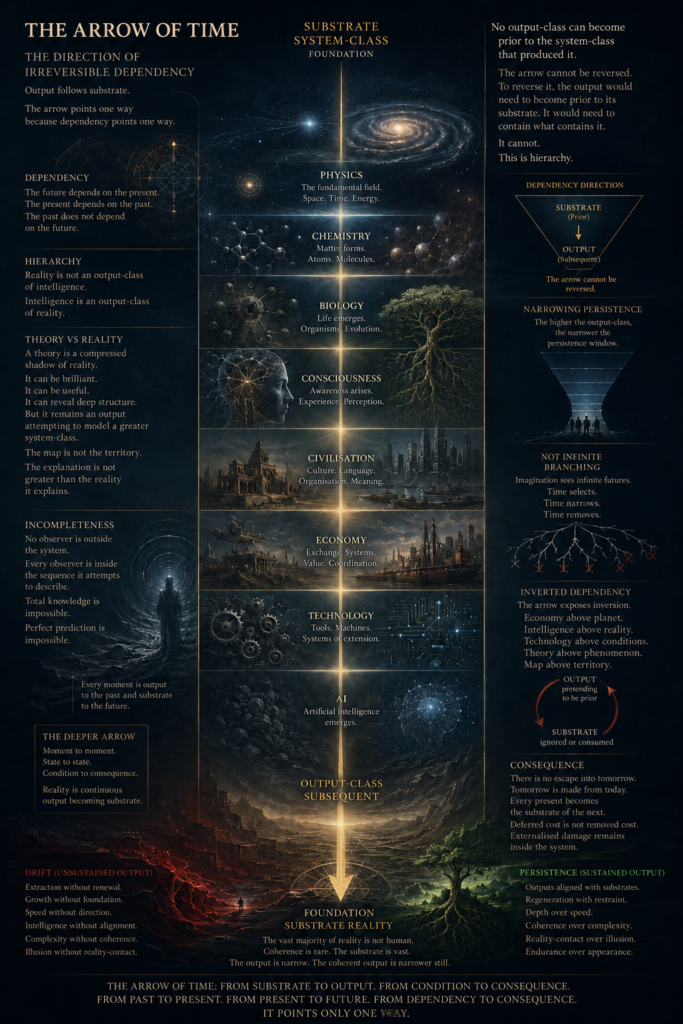
THE ARROW OF TIME
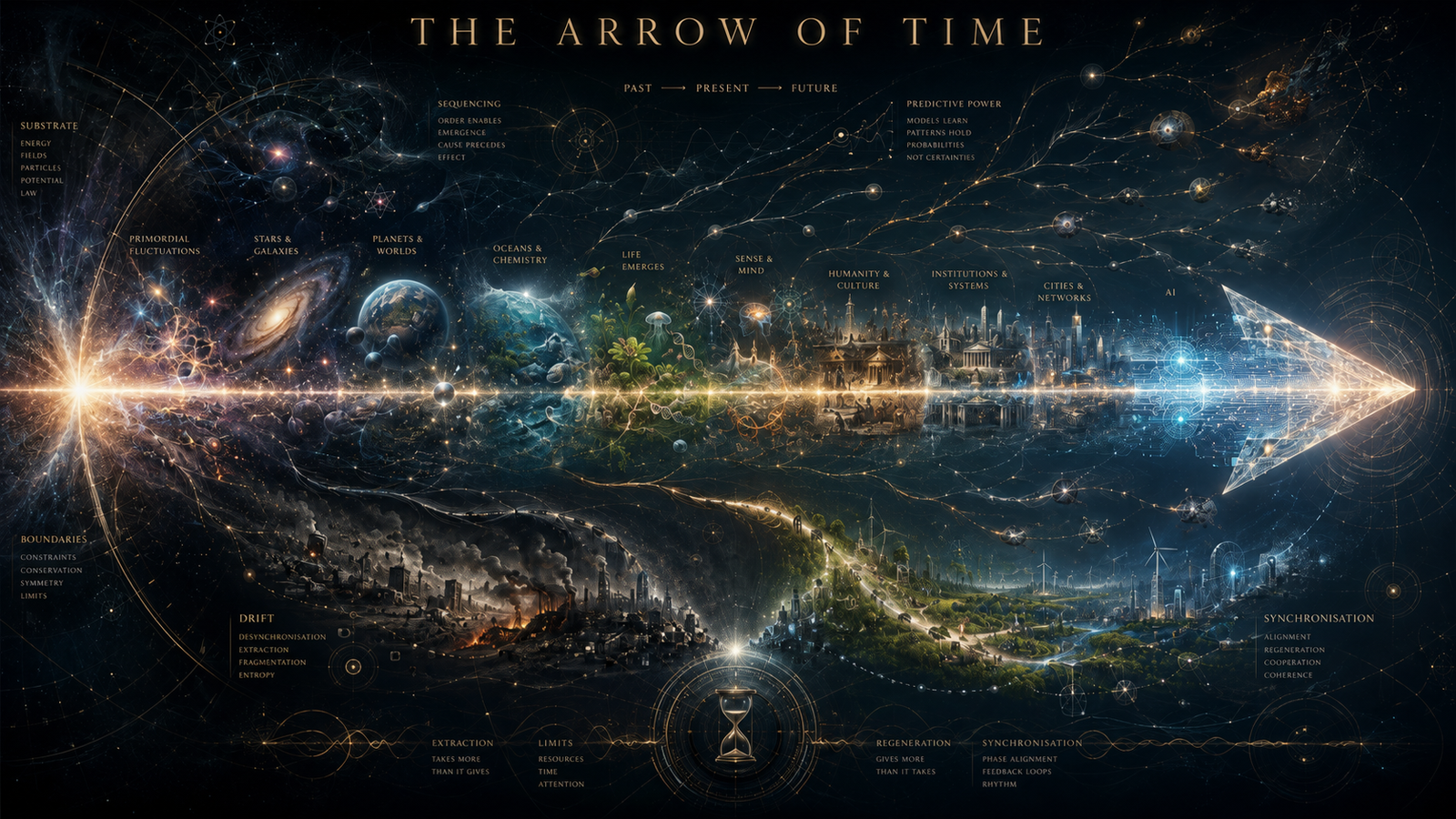
THE ARROW OF TIME
The arrow of time is not only the direction in which clocks move. It is the direction of irreversible dependency.
A seed becomes a tree. A child becomes an adult. A civilisation rises from a planet. An economy rises from civilisation. AI rises from consciousness. Output follows substrate.
The arrow points one way because dependency points one way.
The future depends on the present. The present depends on the past. The past does not depend on the future. No output-class can become prior to the system-class that produced it.
No economy becomes the planet that sustains it. No AI becomes the consciousness that generated it. No civilisation becomes the biosphere that carries it.
This is why the arrow cannot simply be reversed. To reverse the arrow, the output would need to become prior to its substrate. It would need to contain what contains it. It would need to fully model what produced it. It would need to step outside the sequence that gave it existence.
It cannot.
This is not a failure of imagination. It is hierarchy.
Reality is not an output-class of intelligence. Intelligence is an output-class of reality.
A theory is not cleverer than the reality it describes. Relativity exists whether the theory of relativity describes it or not. Evolution exists whether the theory of evolution describes it or not. Stars exist whether physics names them or not. Time exists whether clocks measure it or not.
To describe a star is intelligence. To create one would be power. To mistake description for mastery is drift.
A theory is a compressed shadow of reality. It can be brilliant. It can be useful. It can reveal deep structure. But it remains an output of consciousness attempting to model a system-class greater than itself.
The map is not greater than the territory. The measurement is not greater than the measured. The explanation is not greater than the reality it explains.
This is where human intelligence becomes confused. It discovers a pattern and begins to behave as if discovery outranks existence. It names a law and begins to act as if naming is command. It builds a model and begins to mistake compression for possession.
But the thing described remains prior. Reality does not wait for description before it operates. The universe does not require human comprehension to continue. The star burns before the equation. The organism evolves before the theory. Time moves before the clock.
No system can fully comprehend, contain, or overrule the system that produces it. That is the boundary. That is the hierarchy. That is the arrow.
The observer is not outside the system. The observer is an output of the system. The mind that asks about time is already inside time. The civilisation that tries to master reality is already downstream of reality. The AI that tries to model consciousness is already downstream of consciousness.
This is why incompleteness is not an error in knowledge. It is a condition of being inside the thing known.
No mind can fully see the system that contains it. No civilisation can fully see its own timeline. No AI can fully see the conscious and physical substrates that produce it. Every observer is inside the sequence it attempts to describe.
This does not make knowledge useless. It makes total knowledge impossible. It does not make prediction impossible. It makes perfect prediction impossible.
The arrow is therefore not merely a physical problem. It is a positional problem.
Where is the observer?
Inside the system.
Where is the system?
Inside time.
Where is the output?
Downstream of substrate.
That is why the arrow holds.
The named realms are not the total number of realms. They are descriptive compression.
Physics, biology, consciousness, civilisation, AI — these are not the whole structure of reality. They are visible layers named for human comprehension. They are coarse markers inside a dependency chain too fine and continuous to list.
In reality, there is no obvious human-scale limit to the number of substrate-output relations.
Every moment of reality is the output-class of the previous moment and the substrate-class of the next. Every state emerges from prior conditions and becomes the condition for what follows. The present is output to the past and substrate to the future.
This is the deeper arrow.
Not only physics to biology. Not only biology to consciousness. Not only consciousness to civilisation. But moment to moment. State to state. Condition to consequence.
Reality is continuous output becoming substrate.
That is why time moves. Not because the universe owes humanity an explanation. But because every moment inherits from the moment before it, and every moment passes altered constraints to the moment after it.
The past is not simply “gone.” It is embedded. It becomes structure, memory, scar, inheritance, condition.
The future is not simply “open.” It is constrained. It emerges from what the present preserves, damages, amplifies, ignores, repairs, or destroys.
This is why the future is not infinite branching in the way imagination suggests. Human imagination can generate endless futures. Time cannot preserve endless futures.
Time selects. Time narrows. Time removes.
Reality is vast. Coherence is rare.
Most of the universe, as humans know it, is not civilisation. It is not biology. It is not planets. It is not stars. It is mostly void, radiation, dispersed matter, unbound process, background field, silence.
Coherent things are rare. Stars are rare. Planets are rare. Life is rare. Consciousness is rarer. Civilisation is thinner still. Technology is thinner again.
The higher the output-class, the narrower the persistence window.
This is the opposite of the story modernity likes to tell. Modernity often presents outputs as if they are expanding toward infinity: more technology, more data, more production, more complexity, more possibility.
But the arrow shows something colder. The substrate is vast. The output is narrow. The coherent output is narrower still.
A civilisation is not large because it is loud. A technology is not large because it scales. An economy is not large because it counts itself.
The true measure is not volume. It is persistence.
Can the output remain supported by what produced it? Can the layer above remain aligned with the layer beneath? Can the narrow structure endure inside the wider field that sustains it?
That is the arrow’s question.
Not:
What can be imagined?
But:
What can remain?
This is why the arrow matters for civilisation.
Civilisation is an output-class. It is not self-originating. It did not produce the physics that permits it. It did not produce the biology that carries it. It did not produce the planet that holds it. It did not produce the deep conditions of its own possibility.
It inherited them. It depends on them. It transforms them. And if it consumes them faster than they can continue supporting it, the output destabilises.
This is not punishment. This is sequence. This is not morality. This is dependency.
The output may deny the arrow. It may decorate denial. It may build institutions around denial. It may monetise denial. It may automate denial. It may call denial innovation.
But denial remains downstream. And time keeps moving.
The arrow of time exposes inverted dependency.
It exposes the moment an output begins to behave as if it is greater than its substrate. It exposes the economy pretending to outrank the planet. It exposes intelligence pretending to outrank reality. It exposes technology pretending to outrank the conditions that make technology possible. It exposes theory pretending to outrank the phenomenon. It exposes the map pretending to be the world.
This is why the arrow is not just movement. It is correction.
The arrow does not argue with inversion. It carries inversion forward until the dependency breach becomes visible.
If a system consumes its substrate, the next state inherits a weakened substrate. If a civilisation weakens its foundations, the next civilisation-state inherits instability. If an economy treats extraction as wealth, the next economy-state inherits depletion. If intelligence treats description as mastery, the next intelligence-state inherits error.
There is no escape into a future untouched by the present. Tomorrow is made from today. Every present becomes the substrate of the next.
This is why deferred cost is not removed cost. This is why externalised damage remains inside the system. This is why extraction is not wealth if it weakens the substrate that makes wealth possible. This is why power is not power if it destroys what it depends on. This is why intelligence is not intelligence if it cannot hold dependency direction.
The arrow points one way.
From substrate to output. From condition to expression. From past to present. From present to future. From dependency to consequence.
It cannot be reversed by wealth. It cannot be reversed by narrative. It cannot be reversed by technology. It cannot be reversed by AI. It cannot be reversed by belief.
The arrow does not close the future. It removes impossible futures. It does not end imagination. It disciplines imagination. It does not destroy hope. It separates hope from delay.
The future remains. But it is not infinite. It is bounded. It is sequenced. It is dependent. It is inherited.
This is why the Clock must include the arrow.
A clock without the arrow merely measures duration. A Clock with the arrow measures direction.
It does not claim omniscience. It does not claim the full map. It does not stand outside reality and declare the whole.
It performs dead reckoning.
It starts from position. It reads direction. It measures rate. It observes drift. It tracks dependency. It looks for correction.
The Clock is civilisational dead reckoning:
position,
drift,
direction,
constraint,
correction.
That is enough to matter.
A ship does not need to know the whole ocean to know it is drifting off course. A civilisation does not need to know the whole universe to know when output is consuming substrate. A mind does not need total reality to recognise dependency.
Perfect knowledge is not required. Orientation is required.
That is what the arrow gives.
Without the arrow, civilisation sees possibility. With the arrow, civilisation sees sequence.
Without the arrow, wealth looks like possession. With the arrow, wealth becomes persistence.
Without the arrow, power looks like control. With the arrow, power becomes dependency discipline.
Without the arrow, intelligence looks like mastery. With the arrow, intelligence becomes alignment.
Without the arrow, the future looks open. With the arrow, the future becomes legible.
And that is why the arrow points only one way.
The present is output to the past and substrate to the future.
That is the Clock. That is time. That is the arrow.